

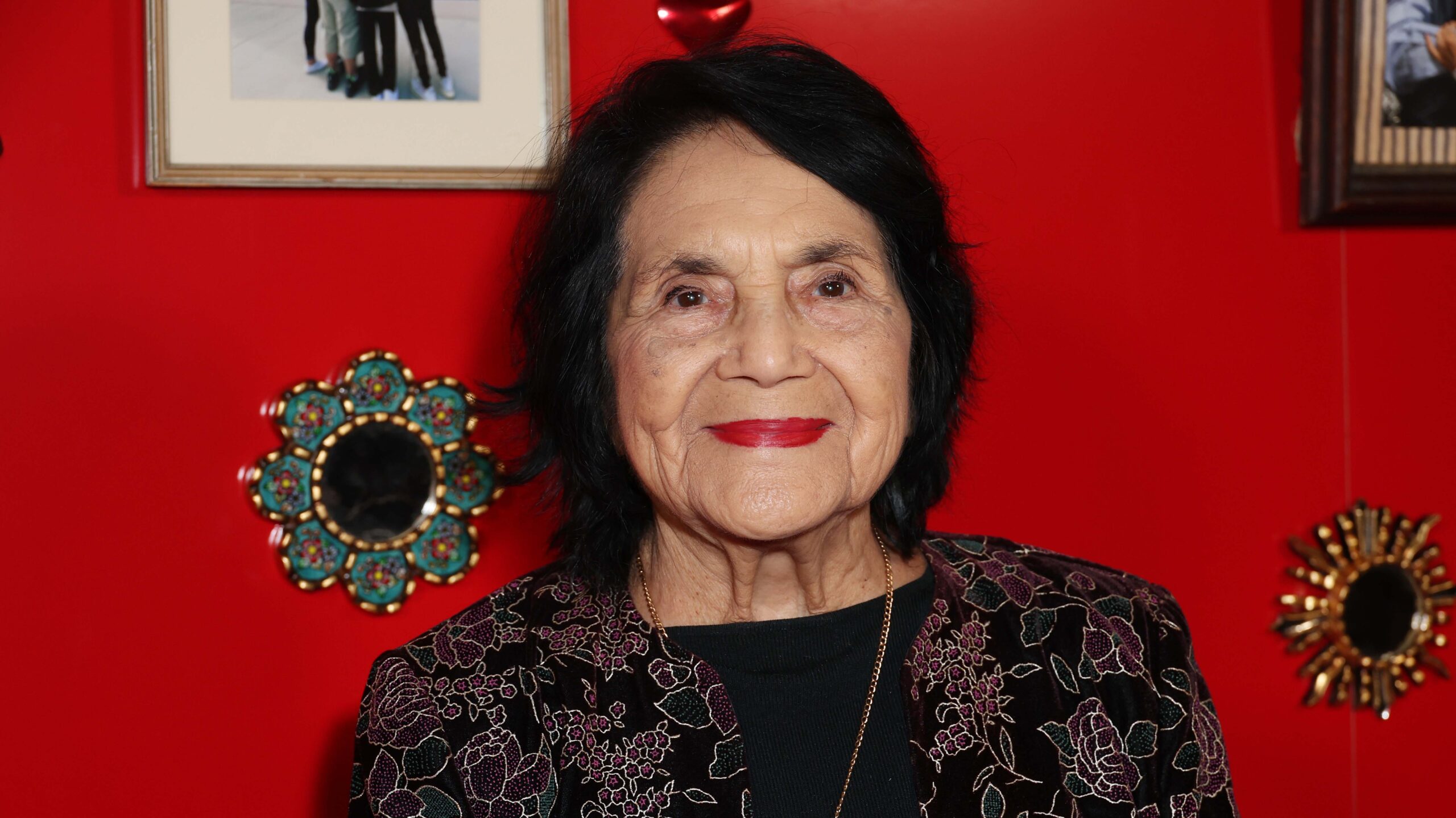
Labor icon Dolores Huerta, who co-founded the United Farm Workers, has died at 96, her family said.
“We are deeply saddened to announce that our beloved mother, Dolores Huerta, has passed away today at the age of 96,” her family said in a statement on her official Instagram account. “As you can imagine, this is an incredibly difficult time for us, and we ask for privacy as we grieve this incredible loss to our family. We know that many of you around the world share in our mourning, and we will be following up on plans to recognize and celebrate her incredible life and legacy.”
A spokesperson for Huerta’s family confirmed her cause of death was cancer.
Huerta co-founded the National Farm Workers Association (NFWA) with fellow activists Cesar Chavez and Gilbert Padilla, which would eventually become the United Farm Workers of America. The union’s work led to the first farmworker union contracts in U.S. history.
The union highlighted Huerta’s coining of the popular labor motto “Si, Se Puede” (“Yes, we can”) and her advocacy for farmworkers, women, immigrants, the LGBTQ+ community and “all marginalized people.”
“Her life’s work was to empower her community to face and overcome injustices, and she has left farm workers and the entire Latino community stronger and more organized than she found it,” said UFW President Teresa Romero.
Huerta was born on April 10, 1930, in Dawson, a small mining town in northern New Mexico to Mexican parents involved in union activism. She grew up in Stockton, California, and became active in community and labor organizations as an adult.
Huerta became a teacher in rural California in the 1950s and said life wasn’t always easy for Mexican-Americans, witnessing mistreatment, extreme poverty and starving children.
“We still have that racism that exists that I had to confront when I was a teenager growing up,” Huerta told “Good Morning America” in 2020.
She began seeing how horrendous life was for farm workers in California.
“They were only earning like 50 cents an hour,” Huerta said. “They had no unemployment insurance, farmworkers, because they migrated from, you know, from county to county. They weren’t even able to have any kind of access to the food banks … no bathrooms in the field, especially for the women. That was really horrible.”
She said she knew it was her calling to fight discrimination and help improve the lives of farmworkers. First, she joined a grassroots group called the Community Service Organization. That’s when she met Chavez and her mentor, Fred Ross Sr., who she calls the godfather of the farmworkers’ movement.
She founded the Agricultural Workers Association in 1960 before joining Chavez and Padilla to form the NFWA two years later.
Huerta played a pivotal role in the Delano grape strike of 1965 and led the subsequent national boycott of table grapes, which successfully pressured growers to improve wages and working conditions.
Huerta founded the Dolores Huerta Foundation in 2002, a civic advocacy organization supporting marginalized, low-income and immigrant communities
She was also a strong advocate for women, campaigning for reproductive rights and serving as an honorary co-chair of the 2017 Women’s March in Washington, D.C.
In 2012, she received the Presidential Medal of Freedom for her decades of advocacy in civil rights and women’s equality.
Allegations against Chavez and continuing work
In 2026, Huerta spoke exclusively to ABC’s John Quiñones in response to a New York Times article detailing allegations that Chavez abused women and minors. Chavez died in 1993.
Huerta said that she was “manipulated and pressured into having sex” with Chavez She detailed two separate sexual encounters with him in the 1960s — one in which she said she was pressured to have sex with him, and another in which she said she was forced against her will.
“And to think that somebody that we looked at as our hero and our leader — you know, it’s pretty horrible,” Huerta said.
Huerta said both encounters she had with Chavez led to pregnancies that she kept secret, later arranging for the children to be raised by other families.
“I thought that abortion was a sin,” Huerta told Quiñones. “I have since changed my mind on those issues because I now realize that women have to have a right to abortion. And by the way, abortion was also illegal at that time.”
She said that one of the children was raised by her brother and the other was raised by a family friend.
Huerta said at the time that she remained committed to her work, focusing on current threats to labor rights and the treatment of immigrants in detention centers.
“My intention is just to do the work, make lives better for women, make lives better for working people,” Huerta said. “We know that the job isn’t finished yet.”
“At my age, 96, as long as God gives me strength and the little energy that I have left, I want to just continue doing the work to make life better for women, for children, and of course, for farmworkers and workers in general,” she said.
Copyright © 2026, ABC Audio. All rights reserved.